24 V, 48 V, 72 V: How Battery Voltage Decides Your Motor Drive
When designing an electric machine — or modernising an existing one — battery voltage is the earliest decision to settle. Voltage does not only define the battery; it defines cable cross-section, contactors, fuses and, above all, the current class of the motor drive. A project that starts at the wrong voltage cannot be fixed later by swapping the drive.
Why Voltage Comes First
Power is roughly voltage times current. Produce the same power at a higher voltage and you draw less current. Less current means thinner cable, smaller contactors, lower copper losses and less heat. On the drive side, a smaller current class does the same job.
Losses are the reason this matters: heat loss in cables and joints rises with the square of the current. Halving the current cuts that loss to a quarter. On vehicles with long cable runs the difference is not small.
Same Power, Three Voltages
Take a traction system drawing 3 kW continuously. Setting efficiency and peak demand aside for a rough calculation, the continuous current expected from the drive changes like this:
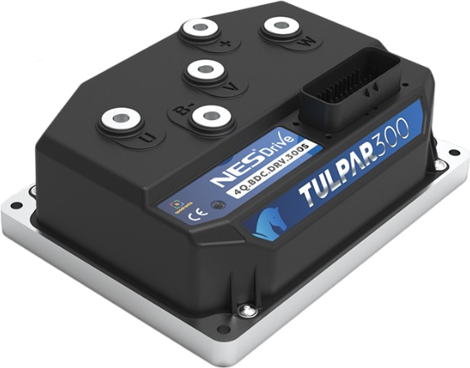
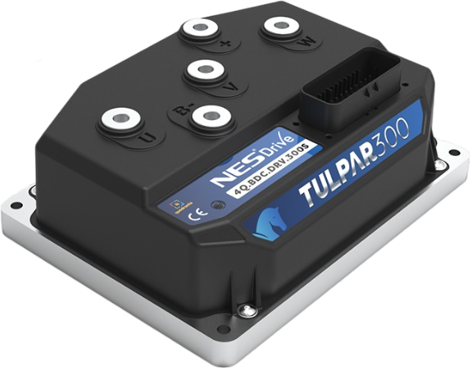
- At 24 V, around 125 A — this calls for a 300 A class drive (TULPAR 300).
- At 48 V, around 63 A — a 75 A rated drive handles it comfortably (TULPAR 275).
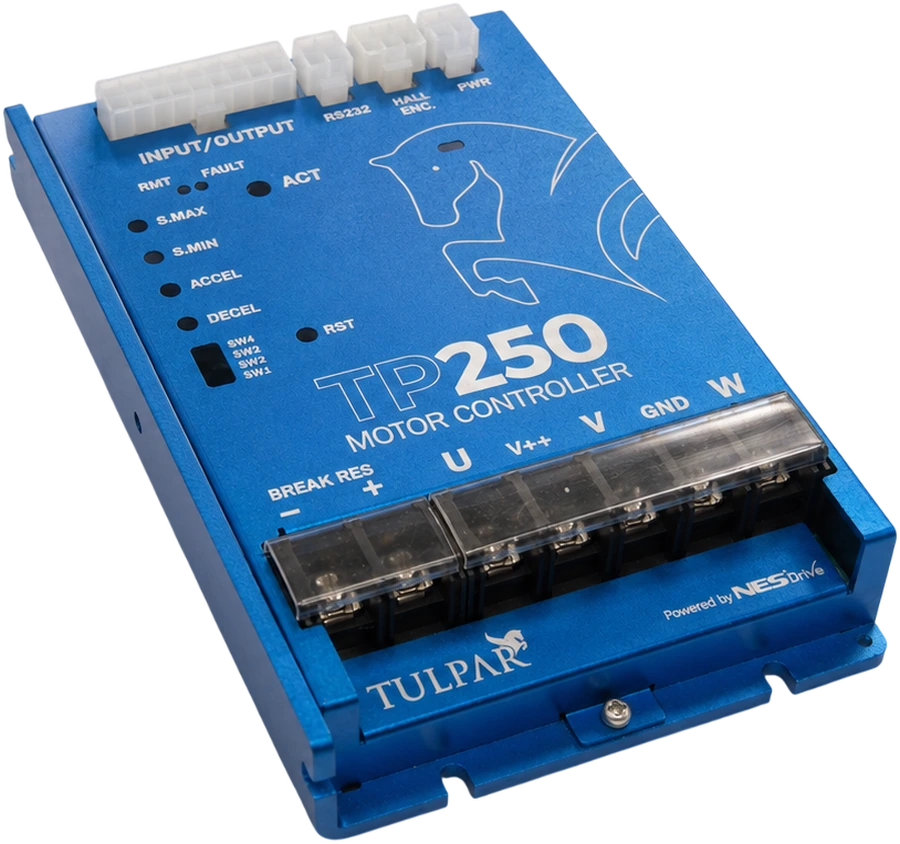
- At 72 V, around 42 A — a 50 A rated drive is enough (TULPAR 250).
Same machine, same work; only the voltage changed, and the drive’s current class dropped to a third. These are rough figures: in a real project, efficiency, starting peak current and duty cycle push them up. They still show the scale of the difference correctly.
What to Weigh When Choosing a Voltage Class
- Existing battery and charging infrastructure: if your fleet already runs on 48 V batteries and chargers, making one machine 72 V adds a new stock item on the operations side.
- The motor nameplate: a motor is wound for a particular voltage. Changing voltage may mean changing the motor as well.
- Cable cross-section and routing: high current needs thick cable, and on tight chassis the bend radius can be a real constraint.
- Peak current demand: on start-up, ramps and lifting, current goes far above the continuous value. Drive selection must be validated against peak current, not continuous.
- Safety and insulation requirements: as voltage rises, insulation, isolation and service safety requirements increase. Where exactly the threshold sits depends on the standard applied to your machine — settle this with your safety engineer.
Voltage Ranges Across NESDrive Models
Filtering by voltage first is the quickest way to narrow the selection. Current ranges:
- TULPAR 300 — 12–48 V and 48–120 V. 300 A rated / 450 A peak. Brushless BLDC / PMSM.
- TULPAR 275 — 12–48 V. 75 A rated / 120 A peak.
- TULPAR 250 — 12–72 V. 50 A rated / 75 A peak.
- TULPAR 200 — 12–48 V. 50 A rated / 55 A peak.
- TULPAR 150 — 12–48 V. 20 A rated / 60 A peak.
- TULPAR 100 — 12–48 V. 10 A rated / 30 A peak.
- BAMSI 300 — 12–72 V. 300 A rated / 450 A peak. Brushed DC.
- BAMSI 200 — 12–48 V. 50 A rated / 100 A peak. Brushed DC.
Worth noting: for a 72 V system, TULPAR 250 covers the brushless side, or the 48–120 V version of TULPAR 300 where high current is needed; on the brushed side, BAMSI 300 sits in range. The 12–48 V band is covered across almost the whole line-up.
Renewing the Drive Without Changing the Battery
A scenario we meet often: the machine runs, battery and motor are in place, but the control board is obsolete or out of spare parts. Here the voltage class is already fixed; the task is to pick a drive that matches the existing voltage and current profile.
On machines with brushed DC motors, modernisation with the BAMSI series is possible without replacing the motor — you gain control, protection and regenerative braking. Moving to a brushless motor means changing motor and drive together, so that decision belongs with the voltage class decision.
Share your application requirements and our engineering team will recommend the best NESDrive model.