What Is STO (Safe Torque Off) on a Motor Drive, and When Do You Need It?
When someone hits the emergency stop on a machine, the motor stopping is not the whole story; the real question is whether the motor can start moving again unexpectedly. STO (Safe Torque Off) is the safety function that answers exactly that question, in hardware. This article covers what STO is, how it differs from a software stop, and where it is expected.
What Is STO?
STO (Safe Torque Off) is a safety function that physically prevents the drive from delivering torque-producing energy to the motor. When STO is active, the drive signals never reach the switching devices in the power stage. The motor cannot produce torque, no matter what the software does.
One point matters here: STO does not brake the motor and does not lock the shaft. A free-running motor can coast on its own inertia, and a suspended load can fall under gravity. STO guarantees “no torque”, not “stopped”. Where a load has to be held, a mechanical brake is still required.
How Is It Different From a Software Stop?
You can also stop a drive with a “stop” command over Modbus or CANopen. But that command travels through the processor, the firmware and the communication link. If the software hangs, the link drops, or a parameter was written incorrectly, any link in that chain can allow motion to continue.
- Software stop: runs through the processor and firmware. It is the right tool in normal operation, but on its own it is not considered a safety function.
- STO: independent of the processor, it cuts the drive path to the power stage directly. A software fault cannot re-open that path.
- Mechanical brake: holds the load. STO removes torque, the brake holds position; the two do not replace each other.
When Do You Need STO?
STO comes into play wherever an operator physically shares space with the machine and motion could cause harm. In practice it is most often required in these scenarios:
- Opening a guard door or breaking a light curtain during maintenance or intervention.
- Machines where the drive has to be part of the emergency stop (E-Stop) chain.
- Automation cells where the operator enters the working envelope to load or unload.
- AGV / AMR and mobile robot applications sharing a floor with people.
- OEM projects where the customer or end user asks for machine safety documentation.
By contrast, in applications where the operator cannot reach moving parts — a pump, fan or conveyor inside a closed cabinet — STO is often not mandatory. The decision follows the machine’s risk assessment, not the drive’s feature list.
What Does an Isolated STO Input Mean?
The STO input is usually driven by a safety relay, a safety PLC or the E-Stop chain. With an isolated (galvanically separated) STO input, that signal line is electrically separated from the drive’s own supply and ground reference.
The practical benefit: the safety circuit and the drive can sit at different ground references, and ground currents or noise travelling through a vehicle chassis will not affect the STO line. In long-cable, high-current, high-vibration vehicle applications in particular, an isolated input reduces the risk of the safety signal being falsely triggered or masked.
STO Across NESDrive Models
STO is not present on every model, so it is worth settling early in the selection process. Here is the current situation on the NESDrive side:
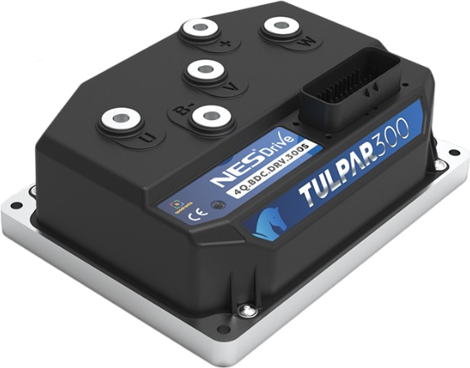
- TULPAR 300 — STO input available. 12–48 / 48–120 V, 300 A rated / 450 A peak.
- TULPAR 275 — Isolated STO input available. 12–48 V, 75 A rated / 120 A peak.
- TULPAR 150 — Isolated STO input available. 12–48 V, 20 A rated / 60 A peak.
- TULPAR 100 — Isolated STO input available. 12–48 V, 10 A rated / 30 A peak.
- TULPAR 250 and TULPAR 200 — no STO input.
- BAMSI series (brushed DC) — no STO input.
The STO row is stated explicitly in the specifications table on each product page and in the datasheet on its downloads page. We recommend checking that row before selecting a drive.
Certification: The Machine Is Certified, Not the Drive
A common misunderstanding: “The drive has STO, so my machine complies with the safety standard.” It does not work that way. The STO input is the building block you need in order to construct the safety function; the level actually achieved depends on the whole chain — safety relay, wiring, category architecture, diagnostic coverage and risk assessment.
So if your project targets a specific performance level (PL) or safety integrity level (SIL), share that target with us before choosing a drive, and we will work out together which model and which wiring arrangement fits.

Share your application requirements and our engineering team will recommend the best NESDrive model.