 Technical
DC Motor Speed Controller or Motor Drive?
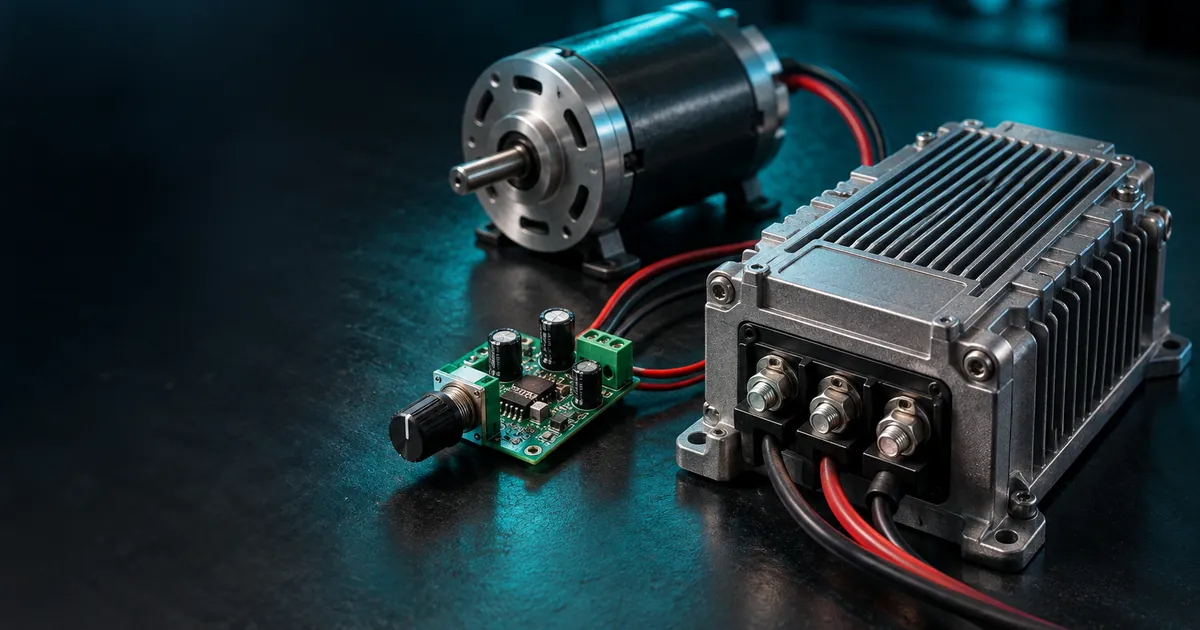
The first thing that comes to mind for adjusting a DC motor’s speed is a PWM speed controller with a potentiometer. For a fan, pump or simple conveyor that may be enough. But when the motor moves a vehicle or a load-carrying mechanism, the difference between a speed controller and a real motor drive becomes a difference in safety and service life.
What Does a PWM Speed Controller Do?
A PWM board switches the motor voltage on and off very quickly to set the average voltage, and therefore the speed. Most are single-direction: they drive the motor forward but cannot control deceleration or brake actively. Current limiting and protection are usually basic, and adjustment is by potentiometer.
What a Motor Drive Does Differently
- Four-quadrant (4Q) control: forward and reverse driving, active braking in both directions.
- Regenerative braking: returns energy to the battery while slowing down and gives controlled descent on ramps.
- Current control: limits torque directly, so start-ups do not strain the motor and drivetrain.
- Protection and diagnostics: overcurrent and over-temperature protection, fault reporting.
- Communication and feedback: links to a PLC or vehicle computer, encoder speed control (model-dependent).
Which One, When?
- A speed controller is enough for low-power, single-direction fans, pumps and simple conveyors that need no braking.
- A motor drive is needed for vehicles, ramp or load-carrying mechanisms, forward/reverse motion, high current and safety-critical applications.
Products like “60A PWM speed controller” are searched for often. Beyond the current on the label, what matters is how long it can carry that current, its cooling and its protection. Driving a vehicle’s traction motor with a simple PWM board leaves deceleration and ramp safety entirely to the mechanical brake.
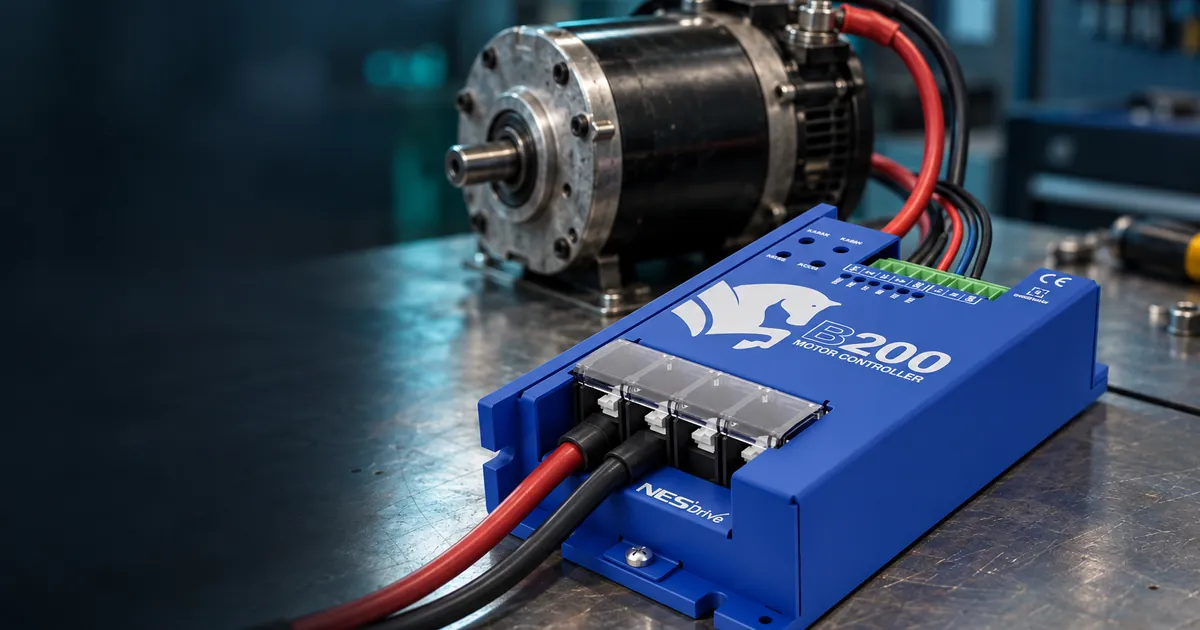
NESDrive BAMSI for Brushed DC
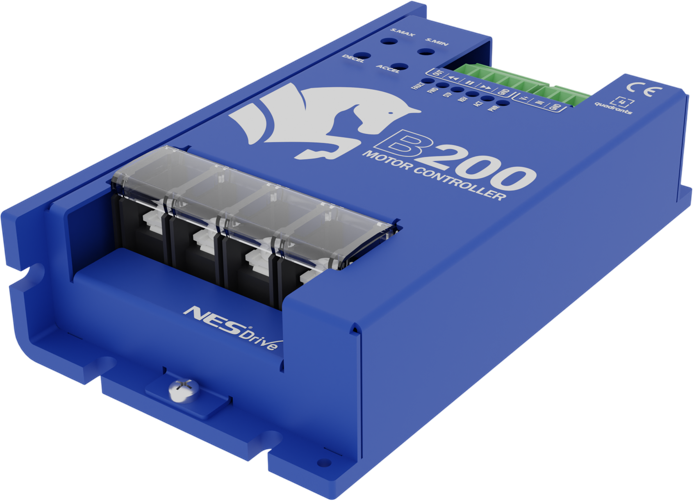
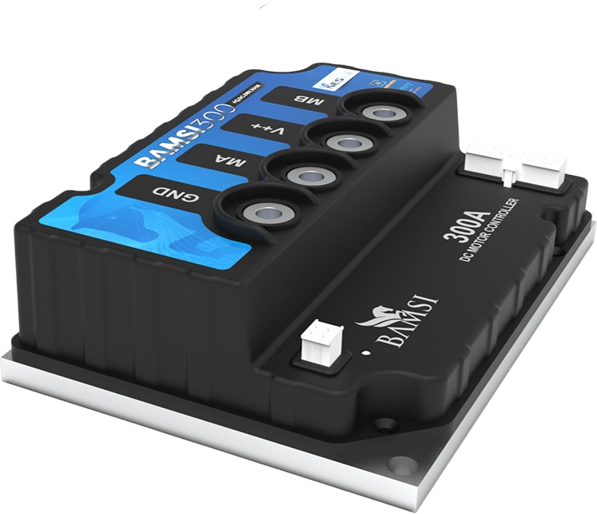
Our DC motor controller series BAMSI for brushed and series-wound DC motors uses a 4Q regenerative topology: BAMSI 200 delivers 50 A rated / 100 A peak at 12–48 V, and BAMSI 300 300 A rated / 450 A peak at 12–72 V.
Share your application requirements and our engineering team will recommend the best NESDrive model.
 Technical
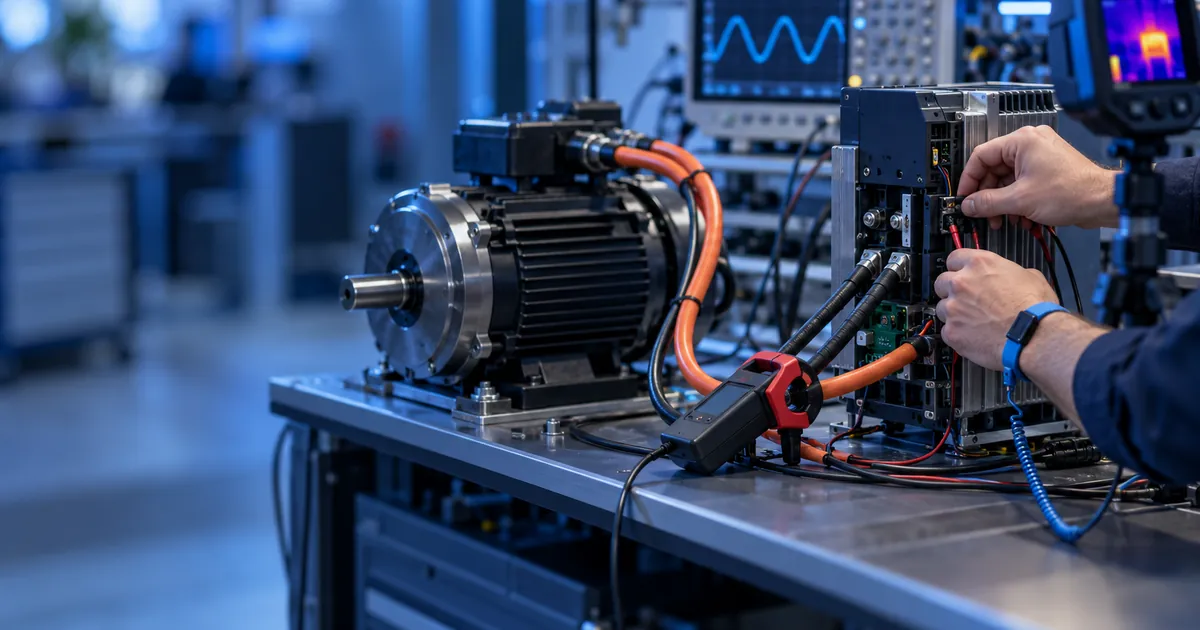
What Do the Protection Layers in a Motor Drive Do?
How overcurrent, over-temperature, reverse polarity and short-circuit protection work, which failures they prevent and what to do when one trips.
 Product
BAMSI 200 Overview: 50 A Brushed DC Controller
BAMSI 200: a 4Q brushed DC motor controller for 12–48 V with 50 A rated and 100 A peak current. Features, applications and how it differs from BAMSI 300.