Motor Drive Guide for Forklifts and Stackers
Electric forklifts and stackers are increasingly common in warehousing and logistics. Their performance, battery life and safety depend directly on the motor drive. So what should you look for when choosing a drive for a forklift application?
Traction or Lift? Different Requirements
A forklift usually has two drive systems: the traction motor turning the wheels and the hydraulic pump motor lifting the fork. The traction motor needs frequent acceleration/deceleration and regenerative braking; the lift motor draws high torque for short periods. These are different current profiles, and the drive must handle both safely.
Current and Voltage by Tonnage
As vehicle tonnage rises, so does required torque and current. Small stackers may need 24–48 V and medium current, while heavy forklifts need 48–80 V and high peak current (e.g. 300–450 A). Peak capacity matters as much as continuous current: instantaneous demand multiplies at start-up and on ramps.
Why Regenerative Braking Matters
4-quadrant (4Q) regenerative drives run the motor as a generator during deceleration and feed energy back to the battery. Even within a single shift this means noticeable battery savings, less heat and less mechanical brake wear — the biggest win for stop-and-go warehouse vehicles.
NESDrive Recommendation
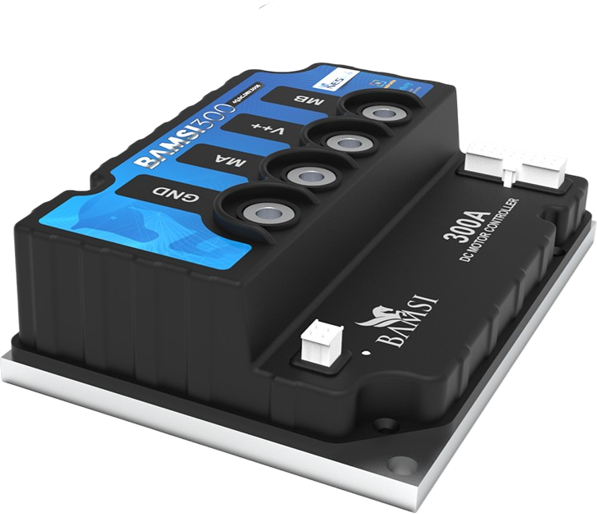
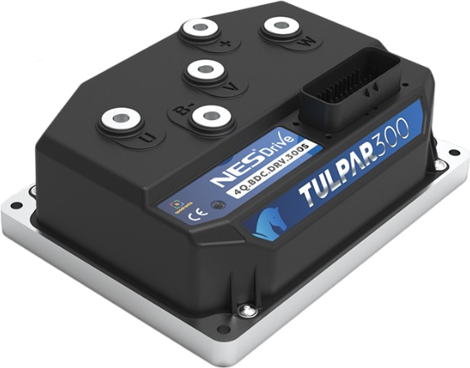
For brushless traction motors, the TULPAR series (e.g. TULPAR 200/250 for mid-class, TULPAR 300 for heavy duty); for brushed DC systems, the BAMSI series (BAMSI 200/300). All are 4Q regenerative, offer CANopen/Modbus and have high peak-current capacity. To pick the exact model, we just need the motor type, voltage and continuous/peak current.
Share your application requirements and our engineering team will recommend the best NESDrive model.