What Is a Motor Drive and How Does It Work?
A motor drive (or motor controller / motor drive board) is an electronic device that controls the speed, torque and direction of an electric motor. Simply put: it takes the fixed power from a source (battery or mains) and delivers it to the motor adjusted to its real-time demand. It is the bridge between the motor's "brain" and its "muscle".
What Does a Motor Drive Do?
If you connect a motor directly to a source, it only spins at full power in one direction — no speed control, soft start, precise positioning or braking. A motor drive enables all of these: stepless speed control, torque limiting, direction changes, higher efficiency and protection against faults.
How Does It Work?
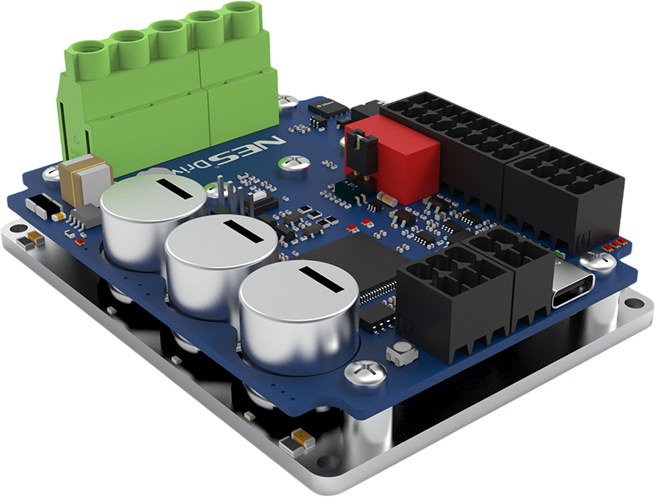
A motor drive has three main parts: (1) Power stage — semiconductor switches (MOSFET/IGBT) rapidly switch power on and off (PWM) to give the motor the desired average voltage. (2) Control stage — a microcontroller (MCU) processes sensor data and triggers the switches at the right moment. (3) Feedback — a Hall sensor, encoder or sensorless algorithm measures speed/position so control is continuously corrected.
Drives by Motor Type
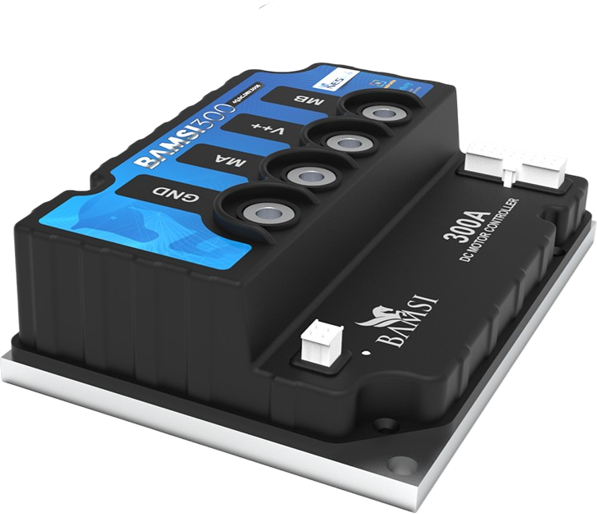
- Brushed DC drive: the simplest; drives brushed DC motors (the BAMSI series at NESDrive).
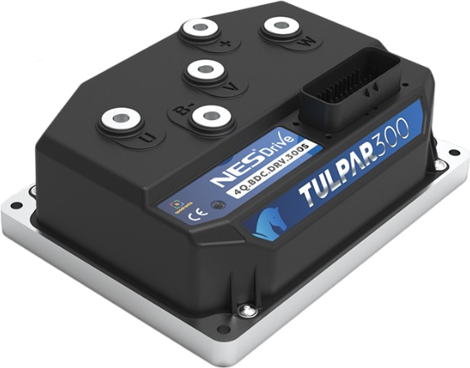
- BLDC / PMSM drive: electronic commutation for brushless motors; high efficiency and precision (TULPAR series).
- AC (ACIM) drive: drives AC induction motors via frequency control; high power and ruggedness.
Where Is It Used?
Electric forklifts and stackers, AGV/AMR robots, electric vehicles, industrial automation, agriculture and defence — motor drives are found almost anywhere there is motion and precise control. The right drive choice directly affects efficiency, life and safety.
Share your application requirements and our engineering team will recommend the best NESDrive model.